Facebook Pixel
Select Page

Behavioural Consulting and Parenting Strategies Langley

Helping Children and Families Thrive

When your child is struggling with big feelings, unwanted behaviors, or challenges at school, it can impact the whole family. At Crossroads Collective, our behavioural consulting programs are designed to support children, parents, and caregivers with effective strategies that improve daily life and create a calmer, more connected home.

Behavioural Consultation

What a Behavioural Consultant Does

During your first consultation, we sit down with you to discuss your child’s unique needs, developmental stage, and daily challenges. Our consultants work closely with parents, teachers, and school counsellors to create a wrap-around plan that supports your child in every environment, home, school, and community.

Behavioural consultants focus on helping children and adolescents:

  • Learn and practice social skills, communication, and play
  • Manage big feelings through self-regulation techniques
  • Develop life skills like independence, problem-solving, and daily routines
  • Improve focus for homework and school tasks
  • Build positive relationships with peers and friends
  • Address difficult or defiant behavior in a way that encourages good behavior and growth

Our sessions may include play-based learning, hands-on teaching moments, and encourage real-world practice in community settings. We use proven treatment methods supported by research to make lasting changes in your child’s life.

Little Girl Holding Father S Hand Looking Camera S 2025 01 27 05 47 12 Utc Scaled

Positive Parenting Strategies

Parents and caregivers are a child’s first and most important teachers. That’s why we include you in every step of the process, offering positive parenting tips, education, and coaching to build confidence and reduce stress at home.

We help parents:

  • Communicate effectively and set clear expectations
  • Use positive parenting techniques such as praise and rewards to encourage good behavior
  • Learn the ABCs of behavior understanding antecedents, behaviors, and consequences
  • Set healthy limits and create consistent rules that children can follow
  • Replace yelling and punishment with calm, structured responses
  • Spend undivided attention time with children to strengthen connection
  • Support kids who may be dealing with depression, anxiety, or autism with compassion and empathy
  • Discover ways to teach safety, independence, and respect at every age

Parent coaching is not about judgment, it’s about giving you the tools and strategies to feel confident, empowered, and motivated to guide your child toward success.

Why It Matters

Every child deserves the chance to thrive, and every parent deserves support. Whether your child is struggling with unwanted behaviors, having trouble at school, or you just want to discover better ways to talk and connect with them, our programs are here to help.

With hard work, consistency, and encouragement, families can see real change. The goal isn’t perfection, it’s progress. Together, we will create a plan that works for your family and helps your child feel safe, supported, and understood.

Woman Working On A Laptop

Our Wraparound Approach

At Crossroads, we use a Wraparound Approach so that your child experiences consistency across all environments.

We collaborate with your child’s caregivers, school, and community-based programs to create goals that align with every area of their life. Our team meets regularly with these supports to ensure your child receives care that makes sense in their world, at their level.

What Is Wraparound?

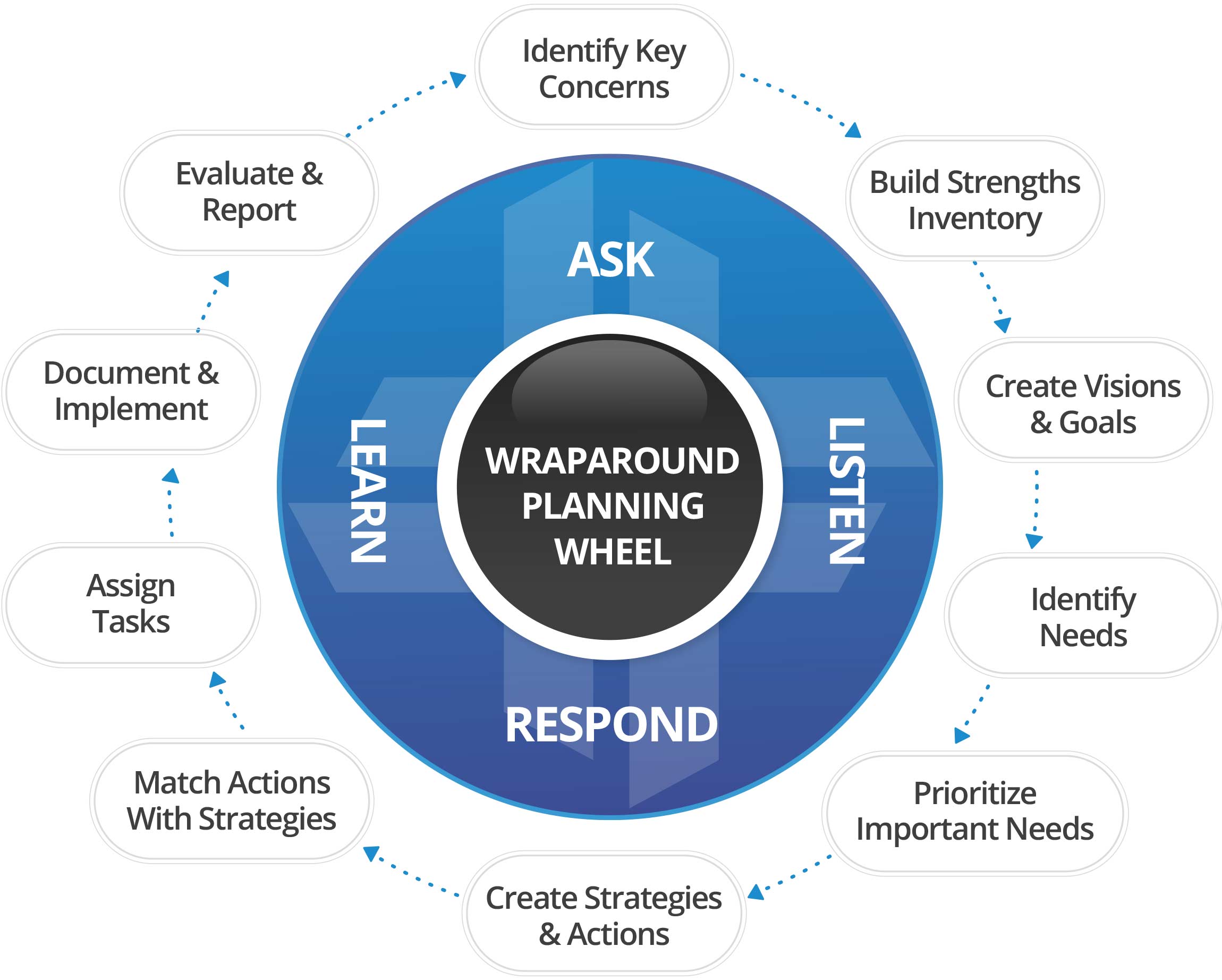
The wraparound approach is a team-based, family-centered model of care designed for children with complex needs. Instead of fragmented systems, wraparound emphasizes collaboration across home, school, and community to create one unified, consistent plan of care.

It’s not a single program, but a process that brings together families, educators, service providers, and community supports to design a customized plan that reflects the child’s strengths and needs.

Behavioural Consultation Wheel

Core Principles

  • Family Voice and Choice: Parents and caregivers are central partners. Their insight guides decisions to ensure strategies are practical at home.
  • Team-Based Planning: Teachers, counsellors, community workers, therapists, and family members collaborate so the child experiences the same expectations everywhere.
  • Individualized Strategies: Plans are tailored to the child’s strengths, cultural background, and specific challenges never one-size-fits-all.
  • Consistency Across Settings: Everyone involved uses the same language, strategies, and reinforcement systems, reducing confusion and helping the child thrive.

How It Works Across Settings

  • At Home: Parents receive coaching to use the same behavioral supports as school, like visual schedules, calm-down tools, and consistent praise. Strategies are adapted for daily routines so they don’t stay “school-based.”
  • At School: Teachers and support staff are trained to mirror home and community expectations, creating predictable structures and consistent interventions.
  • In the Community: After-school programs, sports teams, and mentoring groups reinforce the same strategies, helping the child generalize skills and build resilience.

Benefits of the Wraparound Model

  • Consistent expectations across all environments
  • Stronger skill development and faster progress
  • Reduced confusion and stress for children and families
  • Empowered parents and collaborative schools
  • Sustainable progress that lasts over time

Example in Practice

  • At home, parents create a similar calm space with familiar tools.
  • At school, teachers prompt the child to use it before escalation.
  • In the community, a coach or mentor recognizes and reinforces the same technique.

Over time, the child learns that no matter where they are, the expectations and supports remain consistent helping them feel secure and confident in every setting.

Boy And Younger Sisters With Footballs On Practice Pitch
Enjoying Yummy Food With Her Family

Ready to Support Your Child’s Growth?

Parenting is hard work, but you don’t have to do it alone. Whether your child is struggling to behave, having trouble with friends, or showing signs of frustration at school, we’re here to help. Our team offers a compassionate, research-based approach designed to encourage good behaviour, build confidence, and improve daily life for your whole family.

Call us today or click below to book your initial behavioural consultation and discover effective strategies that work.

We are now accepting virtual appointments as well as in-person appointments.

Click below and schedule your first visit today!

Frequently Asked Questions

How long does it take to see results?

Progress depends on your child’s age and development, but many families notice improvement after a few sessions. The more you repeat and practice the strategies at home, the greater the likelihood of lasting change.

What if my child resists?

Kids often test boundaries at first, that’s normal. We model how to act calmly, use a steady voice, and encourage cooperation without punishment. For example, we may use rewards and positive reinforcement to help them stay motivated.

Do I need to participate?

Yes, parent involvement is important. Think of these sessions as a course in understanding behaviour. We’ll show you how to interact with your child in ways that are encouraging, clear, and consistent so you can keep progress going at home.

What should I do if my child misbehaves again?

Even the best-behaved kids have tough moments no one behaves perfectly 100% of the time. Children are their own people, learning how to act, communicate, and navigate the world. The goal isn’t to control them into compliance, but to understand what the behaviour is telling you. We help you look at what happened before and after the behaviour so you can respond in a way that supports their growth and encourages learning, instead of simply punishing or yelling.  

How do I know my child needs behavioural support?

Watch for signs like frequent outbursts, problems with friends, difficulty following rules, or needing to be reminded to do things over and over. If you feel stuck having the same conversations and aren’t sure what to do next, it might be time to get professional support.

How do I explain play therapy to my child?

You can say: “You’ll be meeting with someone who helps kids by playing with toys, drawing, and games. It’s a safe place where you can share your feelings and have fun.”

How often will my child need sessions?

Most children attend weekly sessions at first. The frequency may reduce as progress is made.

Behavioural Consultant

Abbigeel

Abbigeel McGowan

BA Applied Behaviour Analysis (Autism), BCaBA, RASP Category B

DEMOGRAPHIC: Children and Youth, ages 1-13 years old

SPECIALTIES: Autism, Behaviour Management, Parent Training, Social Skills Groups, Social Thinking, Sibling Coaching, Emotional Regulation, Fine and Gross Motor Skills, Toilet Training, Self-Care Skills, Academic Skills, Communication Skills, ESDM, Play Skills.

aimee-sitiver

Francine de los Reyes

Registered Clinical Counsellor, RCC, CCC

DEMOGRAPHIC: Children, Youth, Adults

SPECIALTIES: ADHD, Anxiety, Autism, Behavioural Management, Boundary Setting, Burnout, Career Counselling, Children and Youth, Emotional Regulation, Educational Counselling, Family Dynamics, Life Transitions, LGBTQ+, Self-Esteem Sexuality, Special Needs, Stress, Relationships

AVAILABLE ONLINE ONLY

Domonique Murdoch

Domonique Murdoch, M.A

MClinical Counsellor, (RCC)

DEMOGRAPHIC: Children, Youth, Adults, Families

SPECIALTIES: Autism, ADHD, PDA, Behaviour Differences, Parenting support for neurodivergent families

AVAILABLE ONLINE ONLY

Behavioural Programmers

tara icon

Tara Anton

Registered Clinical Counsellor (RCC, CCC)

DEMOGRAPHIC: Adults, Couples, Teens, Children

SPECIALTIES: Anxiety, Depression, Parenting Support, ADHD & Neurodiversity, Relationships, Behaviour Issues, Women’s Issues, Parenting Support, Self-esteem/Self-worth, Self-harming, Coping Skills, Trauma, Grief and Loss

LOCATION: Langley, BC

Google Rating
4.3
Based on 121 reviews
js_loader